|
|
|
|
|
Learning
The main organ that processes
learning is the brain. Learning and developmental difficulties are therefore usually
linked to some form of dysfunction of the brain. In the evolution of the human brain,
one of the last attributes to be added was speech. The parts of the brain that are
responsible for processing speech and language are highly specialised and located
on the outside of the left side of the brain, which makes them extremely vulnerable
to traumas to the brain. In contrast the parts of the brain that keep the heart
beating are located deep inside the brain, where they are much better protected
from the external world.
|
Dyslexia
Learning difficulties such as Dyslexia (difficulties with reading), Dysgraphia (difficulties with writing) and Dyscalculia
(difficulties with mathematics) are often
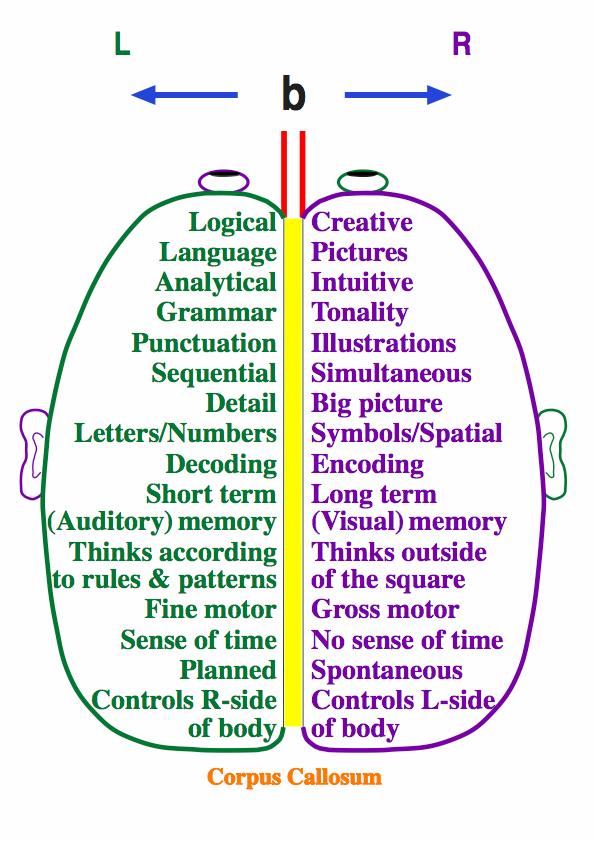
associated with lack of brain access and lack of brain and sensory integration. This is symbolised
by the two red parallel lines in the picture (for more information see
How to improve learning and the SureReading booklet). Many children with Dyslexia make reversals: “b”
for “d”, “on” for “no”. The reason is often because they are left eye dominant.
You can test this by giving them a piece of paper with a hole in the centre and
ask them to hold the piece of paper with their arms stretched out. Now ask them
to look at you through the hole. You will see only one eye, their dominant eye and
if this is the left eye it explains the reversals as the left eye processes information
from right to left (see arrow in the picture). If however the child is right eye dominant and makes
reversals, then this points at lack of brain integration.
|
|
When the brain is not integrated, this means that there are not enough connections
between both sides
of the brain, so that only one eye is looking at the word instead
of both eyes. You can test this by putting a book in your child’s extreme left visual
field and ask him to read a bit. As the left eye will look at the word the child
could see and say “b”, whereas in the right visual field he will see and say “d”.
Because of the visual confusion many dyslexic children also have problems with writing
and spelling. In reading they often have excellent comprehension (a right brain
skill) but have problems with decoding, the process of sounding out a word, letter
by letter, ie c-a-t. They often find phonics and auditory discrimination difficult,
which are both skills that are processed predominantly in the left brain. Dyslexic
children tend to process the world more with the right brain than with the left
brain (see picture above).
As Dyslexia affects the child's ability to learn many subjects at school it can lead to lack of confidence, obstinate
behaviour and refusal to do reading, homework or even refusal to go to school.
Dyspraxia and other speech and language problems
There are many children who suffer from Dyspraxia (difficulty with speech development)
and other speech and language disorders, which can be very debilitating even though
the rest of the body develops normally. Children who come to see me with spelling,
reading or speech problems often have a history of Birth traumas such as lack of
oxygen or forceps deliveries and chemical insults, such as antibiotics and vaccinations
early on in life. In my experience the following is often the case:
|
*
|
Children who have had problems
with speech development early on in life often develop reading, writing and/or spelling
problems in Primary School
|
|
* |
Children who have had a
forceps delivery (especially boys) or frequent ear infections in the first 2 years
of their life have a higher chance of developing spelling problems later on
|
|
* |
Children who are diagnosed with AD(H)D (Attention Deficit (Hyperactivity)
Disorder) have problems with fine motor skills, writing, spelling and decoding
|
There are specific developmental windows in the brain for learning the prerequisite
skills required for reading, writing and spelling. If these windows are missed,
the more advanced skills cannot be learned easily or not at all. If a child cannot hear clearly because of recurrent ear infections whilst speech was developing, they often do not learn to discriminate clearly between the individual sounds in the language (auditory discrimination). Having good Auditory discrimination skills is an
important prerequisite for reading and spelling.
It is every parent’s dream to have a normal, happy and healthy baby. Unfortunately
there are many babies that don’t develop according to the norms and when developmental
milestones are not reached within limits or when an abnormal behaviour starts to
appear alarm bells start ringing. Usually the mother is the first to notice something
is not quite right. Mothers have often told me that they had a sense that something
was not quite right from very early on but if the signs are not very obvious it
can take quite a while until the child is properly diagnosed. Meanwhile valuable
time is lost in which something could be done about it. Early intervention is the
key. This means that all possible causal factors such as diet, nutritional deficiencies,
detoxification pathways, gut health and gut flora, heavy metals, toxins, birth traumas,
brain injuries, lack of brain integration and/or sensory integration need to be
identified and addressed.
From AD(H)D to Autism: Autism Spectrum Disorder
(ASD)
Recently the number of children who are diagnosed with Autism has risen dramatically.
Some children are born with Autism, others have developed “regressive” Autism. In
the case of “regressive” Autism the child develops seemingly normal at first but
after a trigger event the child stops talking, smiling and often stops interacting with its environment and the child regresses. Parents
often tell me that their child has a history of tonsillitis or ear infections that
were treated with antibiotics in the first or second year of life. Following a
vaccination (in particular the MMR vaccination, see http://www.vaccineawakening.blogspot.com/)
their child regressed often due to an overload of toxins within the brain originating
from a dysfunctional gastro-intestinal system with an unbalanced gut flora.
Some of the factors that contribute to this are:
* Poor detoxification ability (often genetically determined)
|
*
|
A poor functioning gut usually with poor gut flora (often caused
by frequent use
of antibiotics early on). This leads to poor digestion and nutrient absorption
(see Nutrition booklet
for more
information). At the same time poor gut flora can produce an increased
amount of toxins
that once absorbed into the brain can compromise brain function
and interfere
with brain development.
|
|
*
|
The presence of heavy metals within the brain. Unfortunately all
Vaccines contain preservatives that have a toxic heavy metal compound. Until recently Methyl-Mercury the most toxic form of Mercury (Thimerosal) was used for all vaccines. Thimerosal is a known neuro-toxin, carcinogen, mutagen, teratogen (causes changes to the genes) and immune system disruptor at levels below 1 ppm. Following the negative side effects and several law suits Thimerosal was replaced
in 1999 by an Aluminium (another heavy metal) based compound in most vaccines. Meanwhile Methyl-Mercury
is still used in some vaccines such as 60% of all flu vaccines, which is often given to pregnant women. To avoid receiving Methyl-Mercury simply ask your doctor to show you the ingredients of a vaccination before being vaccinated against any disease. A Hair Analysis
test can show which metals are circulating in your system and in what quantity.
|
If your child has slow or delayed development it is always worth investigating whether
any of these above factors are present because they are usually treatable.
Behaviour disorders such as Attention Deficit Disorder (ADD) and Attention Deficit
Hyperactivity Disorder (ADHD) also result from a brain (and often a gut) that is not functioning optimally.
The new perspective is that there is a continuum of disorders from mild ADHD on
the left side of the scale, followed by Defiant disorders, Asperger’s Syndrome further
on and severe Autism at the far right.
Can we treat ASD, ADD, ADHD and learning problems?
Yes we can and in all cases it is very important that treatment is started as soon as possible. Early intervention has proven to improve long term outcomes. It can also help to ensure that the child's self-esteem stays in tact.
One of the most successful approaches to regressive Autism Spectrum Disorders (ASD) is the Biomedical approach, a combination of dietary intervention, gut repair, removal of toxins & heavy metals and resolving possible nutrient deficiencies. Many children have made a partial or total recovery of ASD following the Biomedical approach alone (www.MINDD.org).
Even more success can be achieved when the Biomedical approach is combined with modalities such as Herbal medicine, Homeopathy, Brain Gym®, (Educational) Kinesiology, Neuro-Organisation
Technique (NOT) and the SureReading method
Together these treatments can:
* remove toxins that interfere with learning and behaviour
* restore gut flora and gut function
* supply nutrients that improve brain function
* increase access to all areas of the brain
* enhance communication between all areas of the brain
* teach new skills to previously inaccessible areas
|

|
Once the areas of the brain that are involved with the learning process can be accessed we need to teach these areas new skills.
The SureReading method
is designed to identify these missing skills, re-open the
developmental windows
in the brain followed by teaching the missing skills.
|
|
The good news is that often Neuro-Developmental, Learning
and behaviour difficulties can
be overcome!
The How to improve
learning? booklet shows this in the writing examples of “Before” and “After” treatment.
|
|
|
|
|
|
|
|